Overview & Objectives
This lesson immerses students in the harsh reality of World War I, focusing specifically on the daily experiences of soldiers engaged in trench warfare on the Western Front. Students will move beyond simple battle narratives to understand the human cost and gritty details of this unique form of combat.
- Learning Objectives:
- Students will be able to describe at least three major difficulties and three daily routines associated with life in a WWI trench.
- Students will be able to identify key terminology related to trench warfare (e.g., No Man’s Land, trench foot).
- Students will apply their knowledge to empathize with and describe the perspective of a soldier through a creative writing assignment.
- Standards:
- 7.2.2 — The Western Front and Trench Warfare
- Describe the major battles, technological innovations, and conditions of warfare, including trench warfare and its human toll.
- 7.2.3 — Domestic Impact of WWI
- Analyze how wartime experiences affected soldiers and civilians, including social, economic, and emotional consequences.
- 7.2.2 — The Western Front and Trench Warfare
Lesson Activities
- Reading and Annotation: Students receive a non-fiction reading handout titled “Life In The Trenches.” The text details conditions such as rationing, trench foot, rats, and the constant presence of enemy fire. It also details the daily routine of soldiers, such as participating in the everyday “morning hate” sweeping of enemy combatants. Students actively annotate the text to identify key facts and emotional content.
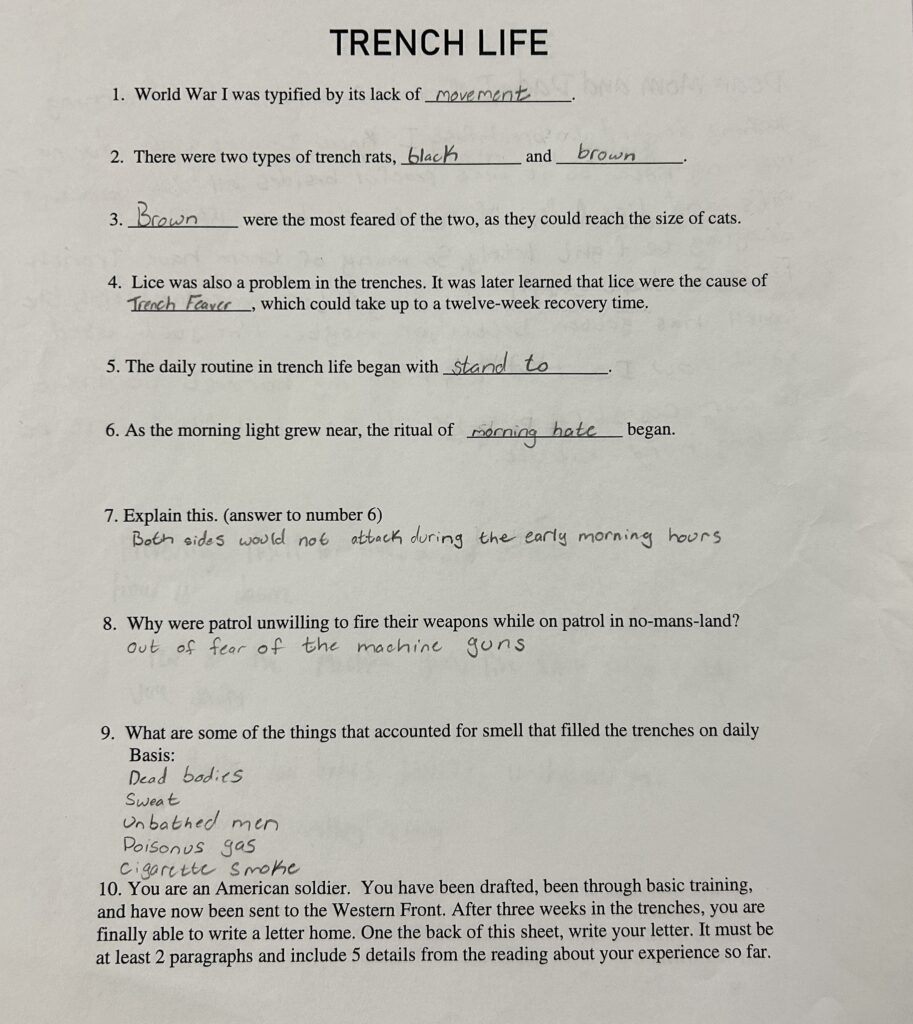
- Knowledge Check (Worksheet): Following the reading, students complete the front page of a worksheet that assesses comprehension. This includes fill-in-the-blank questions to reinforce key vocabulary and short-answer questions requiring them to synthesize information about the daily routines and major challenges faced by soldiers.
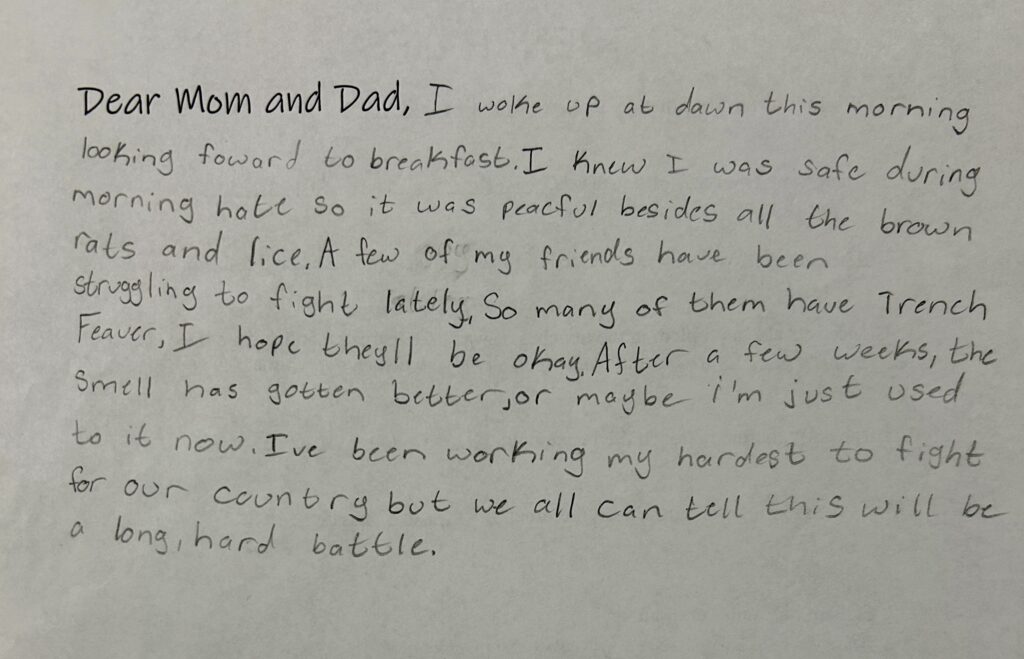
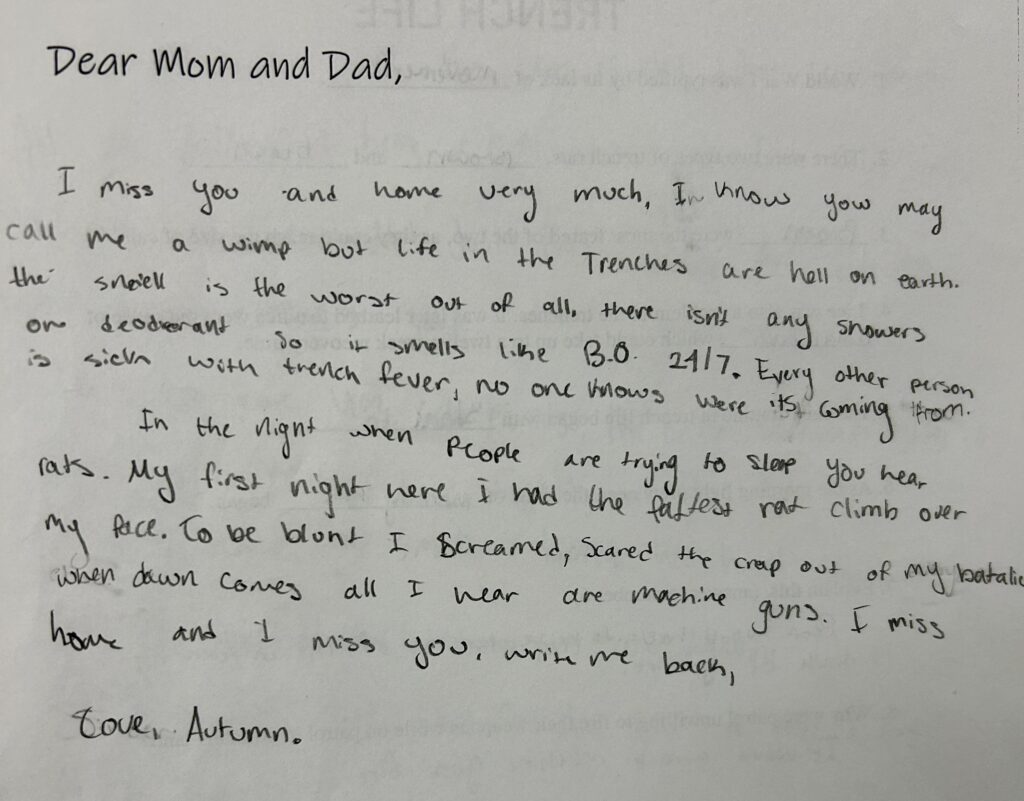
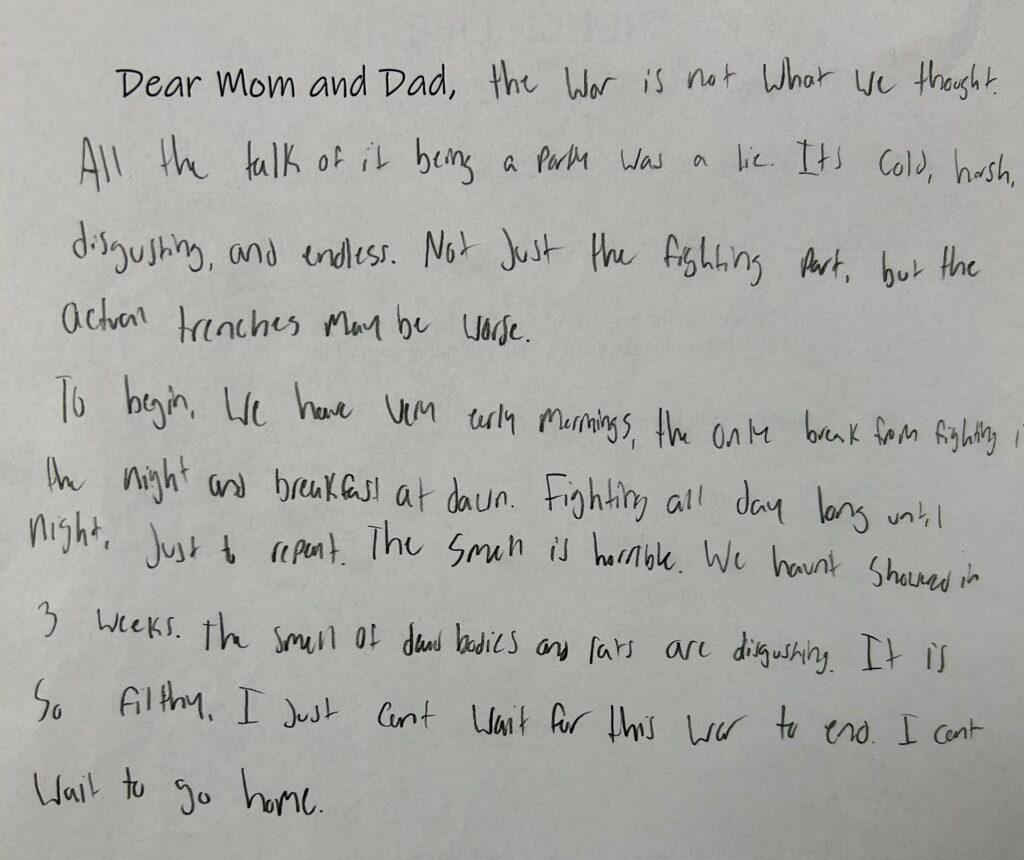
- Creative Application (Role-Playing Letter): The culminating activity requires students to adopt the persona of a newly drafted, trained American soldier (a “Doughboy”). They write a “Dear Mom and Dad” letter home. The letter must incorporate specific, factual details learned from the reading and worksheet about their daily schedule, the living conditions, and their overall emotional state. This allows students to demonstrate understanding through empathetic, narrative writing.
Assessment
Student learning is assessed via two components:
Worksheet Accuracy: Evaluates basic comprehension of facts and vocabulary.
“Dear Mom and Dad” Letter: Assesses the student’s ability to synthesize and apply historical details accurately within a creative, first-person narrative, demonstrating a deeper understanding of the subject matter. - Accommodations: Provide an audio version or shortened version of the reading, along with pre-taught vocabulary or a word bank. Allow extended time, chunked steps, and options to type or dictate responses. Offer sentence starters or a guided template for the letter, and permit alternative formats (e.g., bullet points or audio recording) to demonstrate understanding.